
Four Mitchell County Property Value Figures to Separate
Georgia assessment records stack several linked fields. Reading them as one number invites bad comparisons. Pull the annual notice and parcel card together with the year, parcel ID, property description, and any exemption or special-assessment status before comparing anything.
| Value | What It Is | Where |
|---|---|---|
| Fair market or 100% appraised value | The assessor's full-value estimate for the stated year | Parcel card and PT-306E notice |
| Assessed value | For ordinary Georgia property, 40% of fair market value before later adjustments | Assessor record and assessment notice |
| Net taxable value | The amount after applicable exemptions or special treatment used in the tax calculation | Assessment notice and tax record |
| Recorded sale consideration | Transaction evidence that may be market, nominal, partial-interest, or otherwise qualified | Deed, PT-61, and any assessor sale row |
The 40% figure is an assessment level, not a forecast of a sale price. Nothing sells for 40%. Exemptions lower the taxable figure. The full fair-market value stays untouched, and a recorded transfer can still show zero or nominal consideration even when real economic value changed hands.
Mitchell County Uses Georgia's 40 Percent Assessment Level
Georgia law puts taxable real property at 40% of fair market value, as the Department of Revenue explains. The ratio is the easy part. Once the Board of Tax Assessors sets a full value, the assessed field shows that statutory level before exemptions and other adjustments. The math rarely stops there. Homestead exemptions, conservation or forest programs, and other special-assessment provisions each bend the path from assessed value to net taxable value. That bend matters for farms. Agricultural acreage is not underpriced just because a covenant or special-use field holds down the tax figure. Read the exemption and program fields closely. Then ask the Assessor which rule applies.
Note: Compare figures from the same tax year before treating a difference as an error or trend.
Read Mitchell's PT-306E Fields as a Set
Georgia's PT-306E assessment notice supplies the clearest field vocabulary for any Mitchell County property value review. It lists the parcel, acreage, and prior and current fair-market figures. It also carries the 100% appraised value, 40% assessed value, and exemptions. Net taxable value and estimated taxes appear there too. The notice reports the assessor's determination, not a sales appraisal. Record land and improvement values separately. Check the live card for both figures. A total can shift for many reasons. Land, a building, corrected characteristics, or a new assessment year can all move it. Preserve the notice date. That date controls the appeal window. The appeal process itself belongs with Mitchell County property tax records. But the date stays essential context for the value itself.
The official Georgia property valuation guidance explains the statewide framework the local board follows.
Check a Mitchell County Assessed Value by Parcel
The official assessor search offers three modes: Property Street Address, Owner Name, and Parcel ID. Address works as a first key. Parcel ID works better for returning to one record. Use partial terms when punctuation, a rural road label, or a street type returns no result.
- Open the Mitchell assessor search and run a broad address query.
- Confirm the intended card with its situs, legal description, acreage, and parcel ID.
- Record land, improvement, total fair-market or appraised, assessed, exemption, and net taxable fields with the year.
- Run the exact parcel ID again so the value notes stay tied to the correct tract.
- Check a deed or PT-61 record only when a recorded transaction is needed for comparison.
- Fair market value
- The assessor's estimate of full value under Georgia property-tax rules for the stated year.
- Assessed value
- The value produced by applying the statutory assessment level, generally 40% for ordinary property.
- Assessment level
- The ratio used to convert fair-market value to assessed value.
- Consideration
- An amount reported with a transfer. It may not equal an arm's-length market price.
- Reassessment
- A new determination of value for an assessment year, whether countywide or parcel-specific.
Land and Improvements Tell Different Mitchell County Stories
A parcel card splits value between land and improvements. That split explains a lot. Two nearby tracts with similar acreage can carry different totals because of it. The structures tell one story and the site another. A year-to-year change may sit in either, so note where the movement occurred. Treat building details as mass-appraisal data describing typical characteristics, not actual condition. Read rural acreage with its use treatment. For a city parcel, permits may explain proposed work, but an application never proves the work was finished. Match the permit address to the parcel first.
Recorded Mitchell Sales Need Qualification, Not Just a Price
A deed, PT-61 declaration, or assessor sale row gives you a date and a price. The record may reflect a family transfer, estate transaction, quitclaim, partial interest, entity change, or another event that is not an open-market sale. Qualify every sale by deed type, grantor, and grantee. Check the legal description, codes, and recording reference too. The GSCCCA PT-61 search offers buyer or seller name, county, and date controls. It is useful transaction evidence. Still, it is not today's value. The statewide deed index and the Clerk of Superior Court supply the recorded-instrument path when more context is needed.
Do Not Invent Citywide Value Trends for Camilla, Pelham, or Baconton
No supported city-level revaluation series exists for Mitchell County's three largest cities. Build comparisons from parcels instead. Population, a landmark's age, and comprehensive-plan dates are not substitutes for parcel values. Hold assessor fields, years, types, and flags constant.
City and ZIP labels need care too. Camilla 31730, Pelham 31779, and Baconton 31716 are mailing anchors, not exact tax or municipal boundaries. Compare tax district and jurisdiction fields instead. That matters most near unincorporated land, or where city permitting and county assessment follow separate tracks.
Mitchell County Tax Bills Answer a Different Question
An assessor's figure answers one question: what a parcel is worth on the tax roll. The Tax Commissioner's bill answers another: what the owner of record owes. In Mitchell County the two offices split the work. A tax bill is never a fresh appraisal. It simply applies millage to a taxable value that was set earlier.
A bill can still be useful. It shows taxable value, millage rates, due amounts, penalties, and payment status in one place.
Do not lean on the parcel card for mortgage details, liens, security deeds, or equity. Those live in separate deed records with their own recording dates. Is the question how an assessment became a bill? Is it how to appeal a notice? Then the Mitchell County property tax guide is the better route. Treat the parcel card as one piece, not a whole account statement.
The Mitchell Assessor Page Is the Official Starting Point
The county's Tax Assessor page lists the office's duties plainly. It locates and assesses property, maintains tax records and parcel maps, administers exemptions, and handles assessment appeals.
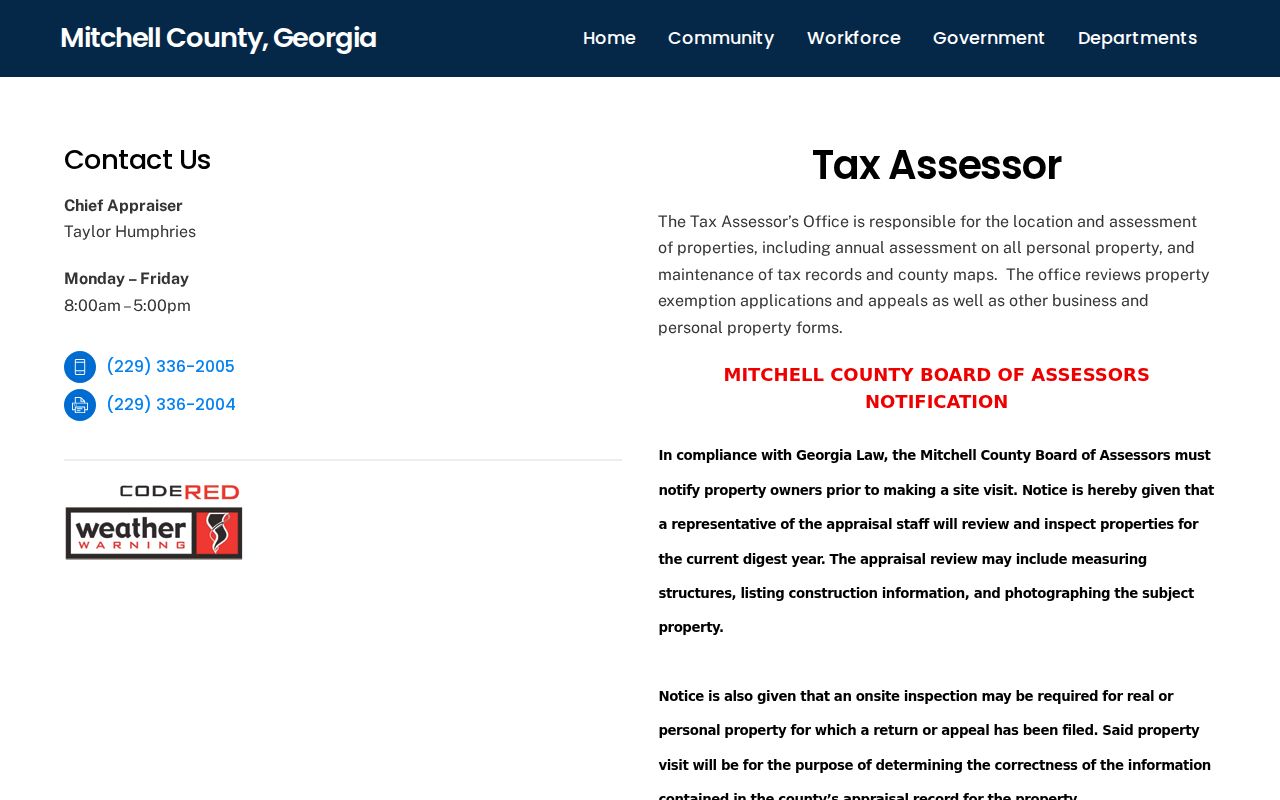
That page describes the office and what it does. For property-specific numbers, use the live parcel search or the annual assessment notice, which also shows the effective year of each value.
What a Mitchell County Property Value Cannot Prove
A Mitchell County assessed value exists for one purpose: property-tax administration. It cannot promise a sale price, vouch for a building's condition, settle a boundary dispute, prove clear title, or replace a current appraisal. The figure may also differ from a recent transfer, since the assessment year, the transaction type, any exemptions, and the timing of data updates rarely line up.
Value is not price. A Mitchell County assessed value supports taxation and is not a promise of what the property would sell for. Use a qualified appraisal for a current market opinion.