
Read Mitchell County Deed Records
Every Mitchell County deed gets filed with the Clerk of Superior Court. The index can cover deeds, security deeds, assignments, releases, easements, plats, liens, and more. Each entry only shows what was presented and indexed. That is worth repeating. An indexed instrument does not prove the grantor held clear title or that no unrecorded interest exists. Pull the instrument type, the parties, the recording date, and the book and page first. Then read the actual image or order a clerk copy before you rely on it.
| Deed Type | What It Does | Common Use |
|---|---|---|
| Warranty deed | Conveys the stated interest with deed warranties. | Ordinary arms-length transfers |
| Quitclaim deed | Conveys whatever interest the grantor has, if any. | Interest cleanup or related-party transfer |
| Executor or administrator deed | Conveys property under estate authority. | Probate-related transfer |
| Security deed | Secures a debt against real property. | Georgia real-estate financing |
| Tax deed | Records a conveyance arising from tax-sale procedure. | Delinquent-tax property |
A security deed or lien is an encumbrance, meaning a recorded claim tied to the land. It is not an ownership deed. Read any later assignment, cancellation, or release alongside the original filing, since the follow-up paper can change what the first one means. A plat shows lots and survey detail. An easement records a right affecting access or use. The statewide entry point is the official GSCCCA Real Estate Search.
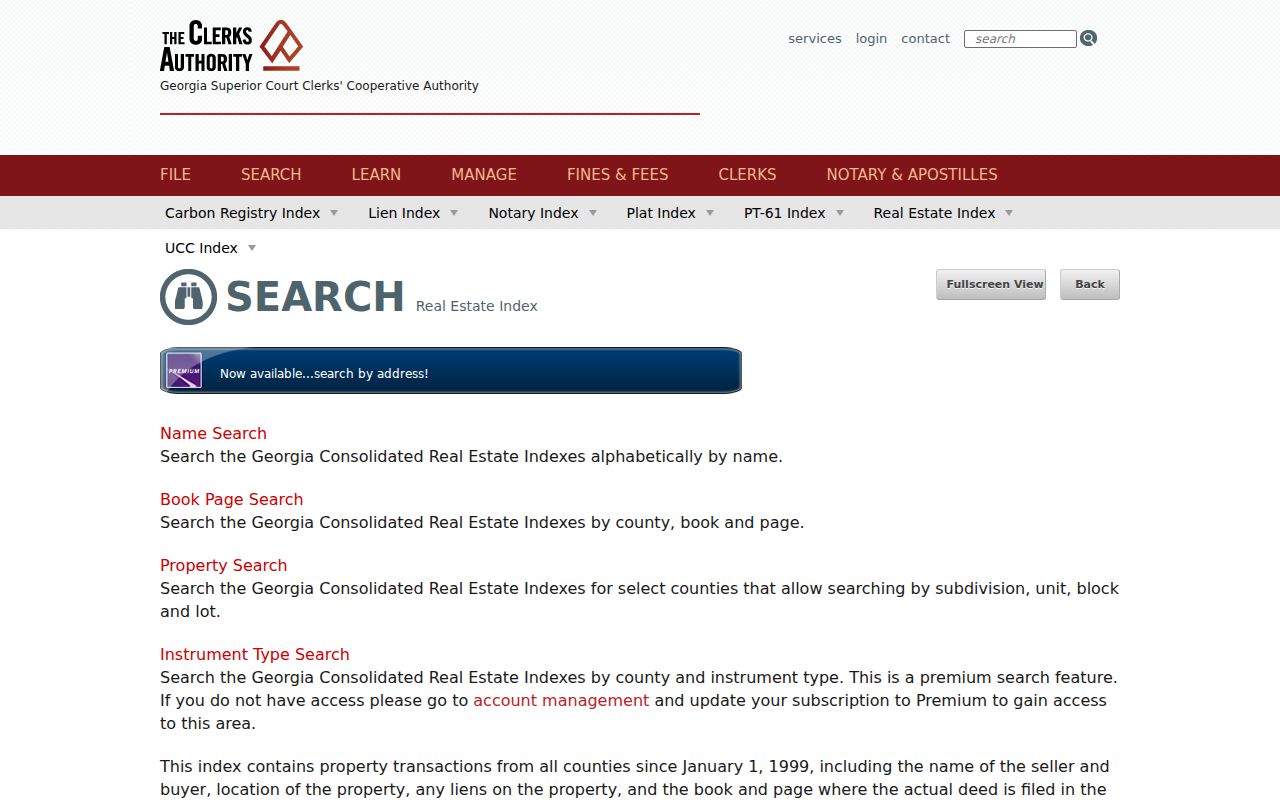
The statewide index is the route in. From there, open the Mitchell instrument image and match it against the land description before trusting the result.
Trace Mitchell Grantors and Grantees
The GSCCCA name search lets you pick county, party type, name, instrument type, and date range. A grantor transfers an interest. A grantee receives it. Search both roles, because the same owner may surface as buyer, seller, borrower, lender, executor, or entity representative across a deed file.
- Find the present owner's acquisition deed by searching that owner as grantee.
- Read the grantor, legal description, instrument type, and recording reference.
- Search that grantor as an earlier grantee and compare the same land description.
- Repeat until the online index ends, then use book indexes at the clerk or an archive.
- Grantor
- The party transferring the stated interest.
- Grantee
- The party receiving the stated interest.
- Chain of title
- The linked sequence of conveyances for the same land.
- Book and page
- The recorded volume and page reference used to retrieve an instrument.
Names alone prove little. Match acreage, land lot, district, subdivision, lot and block, and any metes-and-bounds wording, and stop when the descriptions no longer describe the same tract.
Use the Mitchell Deed Search Forms
The GSCCCA real-estate index offers three routes: name, book and page, and property or subdivision. Its name form handles party type, county, instrument, date range, neighboring counties, and display settings. A parcel card or prior deed may give you the citation already. Then the book and page search is the faster door. The property form depends on participating-county indexing. Treat it as a supplement rather than a replacement for a party search.
Save the instrument ID, record date, county, and party roles from each hit. Also save the instrument type, book and page, and any location fields. Image access varies by county and by year. A result row is only an index pointer. Open the image. Then judge warranties, reservations, easements, or the land conveyed.
Note: Try spelling variants for initials, suffixes, estates, trusts, and companies, then confirm each match by legal description.
Understand Mitchell Online Coverage
GSCCAA reports that real-estate transactions from every Georgia county are online from at least January 1, 1999. Records from 1993 through 1998 are being added. Mitchell County's exact older cutoff is not stated. So do not assume an earlier starting year. An empty result can mean the record predates coverage. It can also mean a different spelling or another instrument type.
For older deeds, go to the Clerk of Superior Court. The office holds direct and reverse indexes, deed books, and plat books. The FamilySearch Georgia wills and deeds collection can offer another lead. Image access and coverage vary, though. The Georgia Archives catalog and local library holdings may point to specific volumes. None of these substitutes for the clerk's official record.
Read Mitchell Book and Page Data
A book and page citation is the durable key to most Mitchell deed records. In newer indexes, an instrument number does the same job. Record both when both appear. The recording date marks when the clerk accepted the filing, which may differ from the date the parties signed. That gap matters when you sequence transfers.
The legal description controls the match. Street addresses change, and old deeds often omit them. Lot and block wording points to a subdivision plat. Land-lot and district references anchor rural parcels. Metes and bounds walk the tract's boundary course by course. Easement and right-of-way language can affect access without conveying the whole parcel.
Handle the consideration figure with care too. Georgia PT-61 transfer-tax data may preserve transaction details, but nominal or zero consideration shows up in family, estate, entity, and corrective transfers. It is never an automatic market appraisal.
Follow Mitchell Security Deed Releases
Georgia typically finances real estate through a security deed. Search both the borrower and the lender. Look next for an assignment if the secured interest changed hands, and for a cancellation or release if the obligation was later cleared. One filing rarely tells the whole loan story.
Liens, fi fas, UCC-related entries, and court notices can also sit beside the deed records. Match each one by parties, dates, amount or instrument reference, and property wording. A similar name is not enough. In litigation such as quiet title, partition, or lien enforcement, the deed index may carry the notice while the court file holds the pleadings and the final disposition.
Monitor Future Mitchell Filings
Want a heads-up on new filings? The GSCCCA Filing Notification System, known as FANS, does that. An authorized user registers names, addresses, or document criteria and receives alerts about future indexed filings. The terms are clear about one limit: alerts depend on what clerks index and transmit. Registrations last one year. Renewal is required after that.
FANS looks forward, never backward. It cannot rebuild an old chain of title, catch every case of fraud, or stand in for a title search. When a notice arrives, pull the actual instrument and review it. Questions go to the clerk or to legal counsel.
Obtain a Mitchell County Deed
Getting a copy of a Mitchell County deed is straightforward. Open the indexed image when one is available. Otherwise, give the Clerk of Superior Court the county, the book and page, the instrument number, the parties, and the record date. Ask whether a plain or certified copy suits your purpose. The clerk's certification fee schedule is not published, so confirm the total before ordering. GSCCCA account material lists a per-page printing charge, but that figure does not describe Mitchell clerk certification fees.
Watch the address details. Official pages conflict. The South Georgia Judicial Circuit lists 26 North Court Street, PO Box 427, Camilla, with phone 229-336-2022, while an older county page shows different counter details. Verify before you visit or mail a request.
Recorded, not guaranteed. Mitchell County deed records show instruments accepted for recording. They are not a title opinion, and unrecorded interests may exist.