
Mitchell Deed Chain Backward
Work from the newest deed first. The grantee is the buyer, and the grantor is the party who sold. Search that grantor's own name as an earlier grantee. Then keep stepping back the same way. Only link two records when the legal description still points to the same parcel. The land must match in both.
| Source | Years It Covers | Where Held | What It Shows |
|---|---|---|---|
| Newest transfer | Current grantee | Prior grantor | Deed type and book/page |
| Prior transfer | That grantor as earlier grantee | Earlier grantor | Same tract description |
| Earlier online step | Name and county index | Earlier transferring party | Date and image check |
| Offline continuation | Clerk index and deed book | Book-era parties | Volume, page, plat, and notes |
Treat your table as a timeline, not a title opinion. Add a row only after the legal description matches. Old rural tracts make a street address alone weak evidence.
GSCCCA's Mitchell Name Fields
The GSCCCA grantor-grantee search lets you filter by party type, county, instrument, name, date range, neighboring county, and display options. Set the county to Mitchell, pick the correct party role, and try alternate spellings or initials when a name shifts across deed records. The official search page shows the same controls you need to reconstruct previous owners.
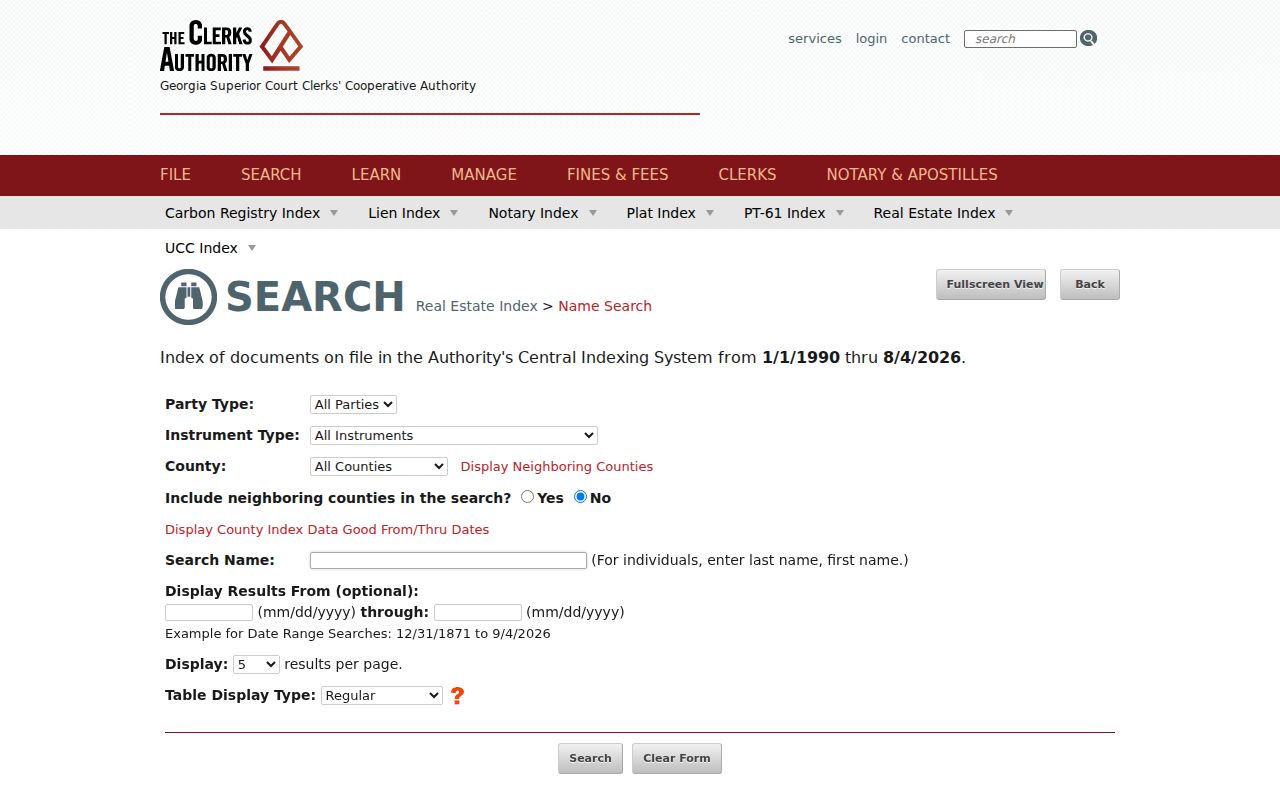
Copy down the instrument reference and recording date before you step back to an earlier generation.
Reconstruct Mitchell's Prior Owners
In Mitchell County, the Clerk of Superior Court keeps the deed and plat records. For online searching, the GSCCCA index covers the whole state. Walk the chain backward, one transfer at a time.
- Find the present owner's acquisition deed and verify the land description.
- Record the grantor, grantee, deed type, instrument and recording dates, and book/page.
- Search the prior grantor as a grantee, then match that earlier deed to the same tract.
- At the online limit, continue through the clerk's reverse index and deed books.
- Grantor and grantee
- The transferring and receiving parties on a deed.
- Chain of title
- The ordered sequence of documents transferring the land.
- Reverse index
- An index used to find instruments by a grantor or grantee role.
- Quitclaim deed
- A deed conveying whatever interest the grantor has without a broad title promise.
Mitchell's Online Chain Limit
GSCCCA posts Georgia real-estate transactions online from January 1, 1999 forward, with 1993 through 1998 still being added. Mitchell County's exact pre-1999 cutoff is not published. Remember that a gap online never means the ownership history begins there.
Older chain required. When the index stops, take the last book/page and party names to the Clerk of Superior Court for the office index, deed book, plat, or public terminal.
FamilySearch holds Georgia deed, will, and probate collections, though access differs by image and place. Its catalog lists each title with its place, author, subject, and film or digital status. Treat any catalog hit as a lead. The Mitchell County volume itself is still the record to check.
Mitchell Estates Break Name Chains
Estate transfers hide behind many labels. A Mitchell County death transfer might name an executor, an administrator, heirs, a trust, or a court order rather than the family surname you expect. Search the decedent's name with estate-style variants, then line the probate clue up against the first deed that actually moves the land. Mitchell Probate Court handles estates here. The court publishes no confirmed public case index. So a direct request to the court or record custodian is the fallback. Company reorganizations and trusts create the same name-shift problem. When party names change, anchor everything to the legal description.
Plats Track Mitchell Parcel Splits
Sometimes a Mitchell County chain only looks broken. An old parent tract was divided. Lots were combined, or a modern parcel number replaced an earlier map reference. When the deed cites a plat, subdivision, lot, or block, search the GSCCCA plat index. Older or missing items may sit in the clerk's plat book instead. Metes-and-bounds text, land lots, districts, roads, rivers, and easements can identify rural property. That holds true even after a street label changed. Stop if the acreage or boundary calls no longer align. A tax map helps the comparison. It does not settle a boundary.
Directories Supply Mitchell Clues
City directories and newspapers fill gaps the deed books leave open. The Digital Library of Georgia holds Camilla directories from 1941, 1949, and 1970. The Mitchell County Public Library describes newspaper coverage running from 1900 through November 2018. A directory entry can surface an old address, an obituary, a deed notice, a road name, or an estate clue. It lists occupants, businesses, widows, and household ties. It proves no title. Pair the name and address with the deed index, probate record, and tax or plat evidence. Take courthouse chronologies with care, too. Official history sources differ on the earliest courthouse and the fire sequence. No verified list of deed books lost in the fire exists.
Note: Historical context narrows a search. Each former owner still needs a matching land instrument.
Mitchell Consideration Needs Context
A sale amount never tells the whole transfer story. Georgia PT-61 records can add consideration and document detail, yet zero or nominal consideration shows up in family, estate, trust, corrective, and entity transfers. Former owners are established by the parties and the matched land. Never assume each deed was a market sale. For every instrument, record the deed type, date, grantor, grantee, consideration if shown, book and page, and legal description. A quitclaim transfers only whatever interest the grantor holds, with no broad title promises. The GSCCCA PT-61 search is supporting evidence. It is no replacement for the deed itself.
Request Older Mitchell Deeds
Start a clerk request from the most recent fact you can confirm about the property. Mitchell County works best with specifics. Include both party names and a date range. Add the deed type and any book or page number you know. Add the legal description or plat citation if you have it. Request an existing reverse-index entry or volume rather than a new title report. That keeps the search inside the recorder's own holdings.
Copy formats, courthouse inspection, and a fee estimate are all fair questions for the clerk. The county publishes no Mitchell-specific copy schedule, so ask directly about costs. Keep a source log noting each repository and the spellings you tried. Record date ranges, empty results, and citations too. A web search that turns up nothing does not prove a prior owner or deed never existed.
Limits on Mitchell Former Owners
Mitchell County dates to 1857, when it was carved from Baker County. That matters for old land trails. A parcel from before that split may sit in records kept under an earlier county. It may also carry an older description system.
The county publishes no confirmed earliest deed volume and no complete loss list. No county-specific microfilm run is documented either. State archives, FamilySearch, local history collections, and the clerk's deed records remain the practical route. Check each source directly rather than assuming coverage dates.
Lawful use. Former-owner research supports house history, estate work, and land diligence. Never use old or current names to track, harass, or harm a living person.