
Read Mitchell County Tax Records
Read these files field by field, year by year. The assessment notice carries the value framework. It also lists the tax district, any exemptions, and an estimated tax. The bill itself is a collection record, showing account status and amounts due. For proof of a transaction, look instead to the deed or transfer-tax filing. Carry the parcel ID across each document. That keeps an old owner name or a lookalike street address from pointing you to the wrong tract.
| Field | What It Shows | Where |
|---|---|---|
| Fair market value | The county's full value estimate for the notice year | Tax Assessor |
| 40% assessed value | Georgia's statutory assessment level before exemptions | Tax Assessor |
| Exemptions and net taxable | Adjustments used in the tax calculation | Tax Assessor |
| Bill and status | Amount billed, payment, or delinquency information | Tax Commissioner |
| Tax district and millage | The jurisdiction and rate inputs for estimated tax | Notice and tax bill |
Mitchell County property tax records are split between two offices. Each office answers a different question. The Board of Tax Assessors locates property and maintains the maps. It applies exemptions and hears the first round of assessment disputes. The Tax Commissioner sends out bills and pursues delinquent taxes. Fair market value, assessed value, and taxable value are three of the numbers you will see. Bill amount and sale price make five distinct figures in all. Identify the field and record year before reading anything into them. The assessor's duties are summarized on its official Tax Assessor page.
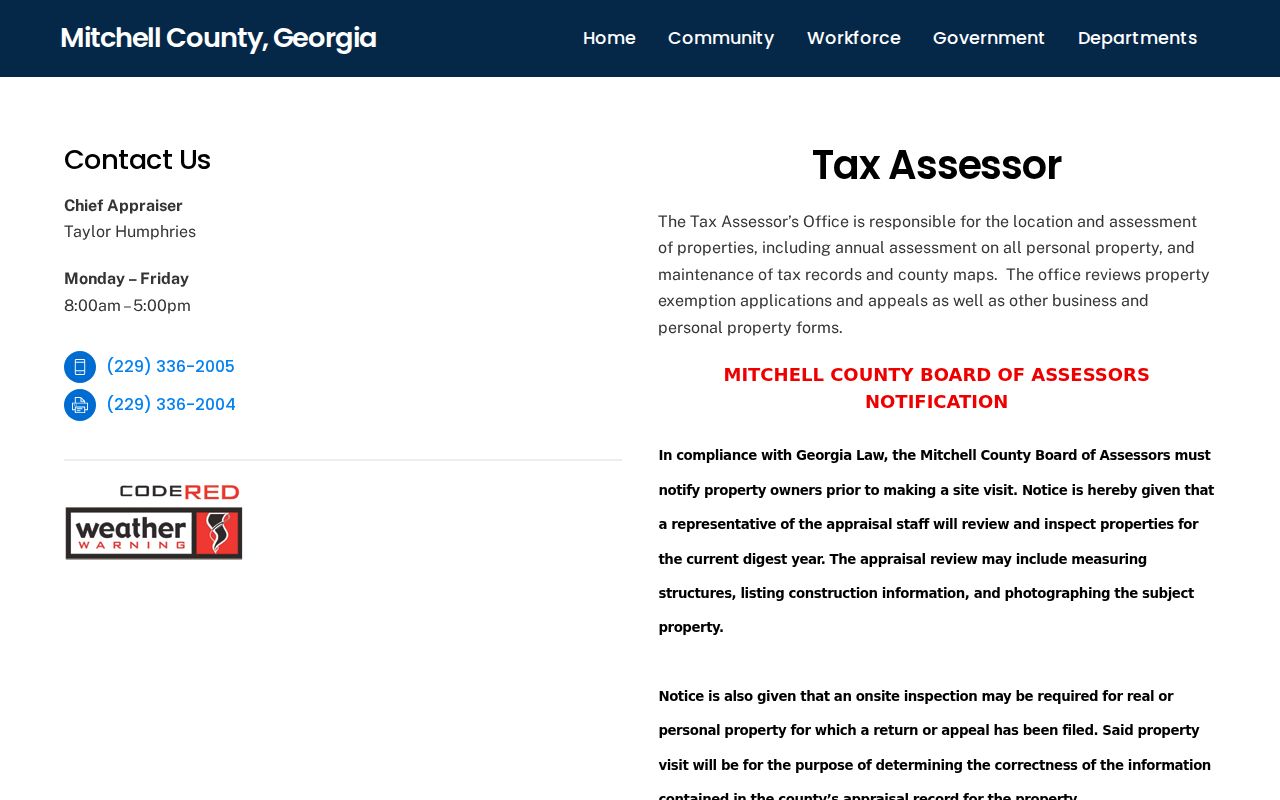
That office page confirms the assessor's role in assessment, mapping, exemptions, and appeals. Collection and payment questions belong to the Tax Commissioner.
Look Up a Mitchell Tax Bill
Start with the assessor property search to pull the parcel ID and tax district. Then take bill and payment questions to the Tax Commissioner site. Some payment lookups route through a third-party portal. So have the office phone number handy as a fallback. The parcel ID is the thread that ties the two lookups together.
- Search the assessor by address or owner and save the parcel ID.
- Open the Tax Commissioner route and match the parcel, taxpayer, and tax year.
- Compare the billed taxable value with the assessment notice and exemptions.
- Ask the office to verify payment, delinquency, or sale status when the portal is blocked or unclear.
- Assessed value
- Forty percent of fair market value in the ordinary Georgia assessment framework.
- Millage rate
- The tax rate applied to taxable value, expressed in mills.
- Homestead exemption
- A qualifying reduction associated with an eligible homestead application.
- Tax lien
- A legal claim arising from unpaid tax, distinct from the ordinary annual bill.
A bill number is only good for the year printed on it. A paid current bill does not prove that older years or other liens are clear. Likewise, the taxpayer named on a bill is not proof of title; the deed records hold that answer.
Read a Mitchell Assessment Notice
Georgia's official PT-306E sample shows how an annual assessment notice is laid out. Fields can include parcel, account, and property IDs, acreage, covenant year, tax district, homestead status, legal and property descriptions, and the property address. Other fields can include taxpayer returned value, prior and current fair market value, 100 percent appraised value, 40 percent assessed value, exemptions, net taxable value, millage, and estimated tax.
The notice is not the bill. Estimated tax can shift once rates are set. Match the notice year, parcel ID, and property description before comparing any values. Land and improvement components can appear. Read them separately, since a change often hits one harder than the other.
Note: Read the notice date first. Georgia's assessment appeal window runs from that mailing date.
Apply Georgia's Forty Percent Rule
Under Georgia law, property is generally assessed at 40 percent of fair market value. The Georgia Department of Revenue valuation guidance spells out the method. A $100,000 fair market figure becomes a $40,000 assessment. That comes before exemptions or special treatment. That is a ratio. It is not a suggestion the parcel would sell for 40 percent of its worth.
Net taxable value can differ from assessed value once exemptions apply. Current-use, conservation, forest, preferential agriculture, homestead, and Freeport programs all appear among Mitchell County assessor resources. Eligibility turns on the specific program and timely filings. Never infer eligibility from how land looks or from an owner's mailing address.
Separate Mitchell Value and Tax Offices
The Mitchell County Tax Assessor handles annual assessment, tax records, maps, exemptions, and appeals. The office page also describes onsite appraisal review, which may involve measuring structures, noting construction details, and taking photographs after the owner is notified. That fieldwork supports valuation. It has nothing to do with collection.
The Tax Commissioner collects real-property, mobile-home, timber, and intangible taxes. Balance, receipt, delinquency, and payment-method questions go there. Its official page lists the county complex on U.S. Highway 19 South in Camilla along with weekday hours. Confirm hours before making the trip.
Check Mitchell Exemption Flags
An exemption field shows what the assessor applied for that tax year. It does not prove occupancy, age, disability, veteran status, or continued eligibility. Use public property tax records to follow the calculation. Do not use them to draw personal conclusions about the taxpayer.
Mitchell's assessor resources include homestead and several land-use forms. Read the specific approval and covenant year where one is shown. A conservation or forest program can change taxable treatment. The fair market estimate stays a separate field. Ask the assessor about any coded entry the card leaves undefined.
Note: A seller's exemption will not automatically carry over to a new owner. Confirm current application requirements with the assessor.
Verify Mitchell Delinquency and Sales
Mitchell County's official tax-sales page leans toward contact information. The county publishes no full public sale list. It posts no bidder calendar and no local redemption-fee schedule. So treat a mere search hit as unconfirmed. Trust the Tax Commissioner on any pending sale. The published legal notices are also authoritative.
A delinquency is not a lien. A lien is not a completed tax sale. Write down the tax year, the amount, the notice date, and the parcel number. If ownership after a sale is in question, pull the recorded tax deed. Then pull every later instrument from the Clerk of Superior Court. Assessor names can lag, so skip them while records update.
Sale status needs confirmation. Contact the Tax Commissioner for the current file and deadlines before acting on any online tax-sale reference.
Compare Mitchell Sale Consideration
A recorded deed or its PT-61 record often states what changed hands. That number is evidence of one transaction. It is not the assessor's current value. It may not reflect a true market price. Family transfers, estate moves, entity shuffles, and corrective deeds can all show nominal or zero consideration. Read the reason and qualification codes.
Line up the transfer date with the assessment year next. Then read the deed beside the parcel card's sale row. A later improvement, a parcel split, a new exemption, or plain market drift can pull the two figures apart. Neither record is wrong.
Appeal a Mitchell County Assessment
Georgia gives you 45 days to file an appeal. The clock starts on the date on your assessment notice. Miss that window and the valuation stands. Mitchell County owners have several routes. The PT-311A guidance along with the county's local appeal form lays them out. You can go before the Board of Equalization. A hearing officer handles qualifying matters. Arbitration is another choice. File with the county assessor as the notice directs. Keep proof that your appeal arrived on time.
Strong evidence makes a real difference. Bring the notice itself. Bring the parcel card, photographs, repair estimates, comparable sales, the recorded deed, and a plat. Then explain plainly which value or classification you dispute. Don't wait for the tax bill to raise a late valuation challenge. Ask the assessor instead how payment is handled while your appeal remains open.
Appeal window. A Mitchell County assessment appeal must be filed within 45 days of the notice date. Missing that period can forfeit the year's ordinary appeal route.